

.png)
In the commercial vehicle industry, time is literally money. Traditionally, assessing vehicle damage has been a bottleneck characterized by manual inspections, subjective estimations, and lengthy wait times. At Checkturio, we are eliminating this friction by fusing Computer Vision (CV) with robust Predictive Analytics to deliver instant, data-driven cost estimates.
Here is an inside look at the engineering and data science that powers our vehicle damage estimator.
Before our engine can calculate a price tag, we first employ the Computer Vision to assess the vehicle damage. The process begins when a user captures a photo of the damage. Our pipeline then executes two concurrent deep learning tasks:
As shown in the example below, when a "Tipper Body" is identified with a "Bent" damage type, the system doesn't just see a shape; it identifies a specific repairable asset.
In the world of Machine Learning, your model is only as reliable as its training set. We believe that empirical precision is anchored in the quality of the foundation, which is why our cost estimation model isn't based on simulations, but on real-world ground truth.
Our predictive engine is built on commercial vehicle inspection reports performed by an independent, certified organization.
Once the ML models have identified the part and the damage type, the Predictive Analytics engine takes the lead.
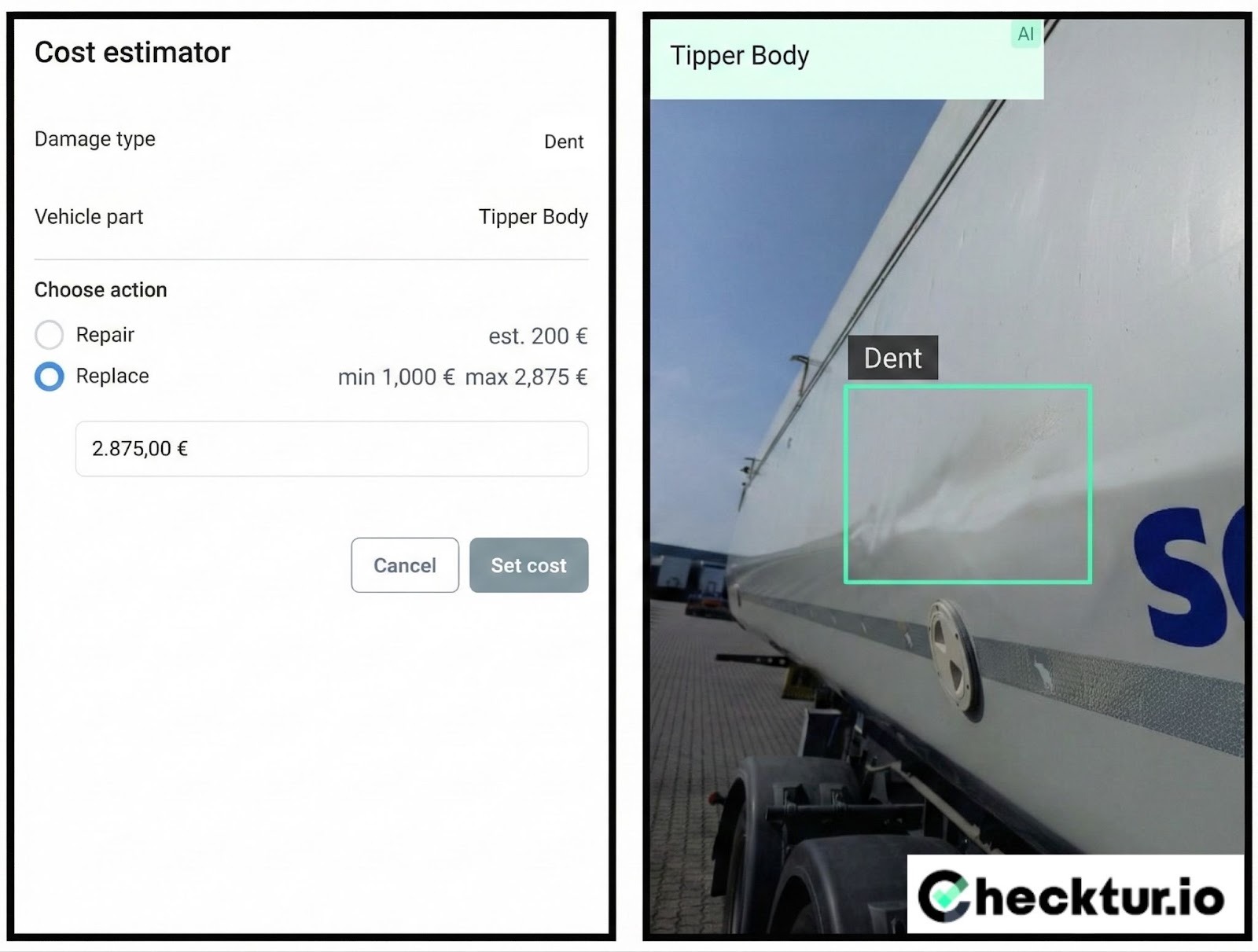
As seen in our UI, the system provides a logical range (e.g., Repair vs. Replace), giving fleet managers and insurance providers the flexibility to set costs based on data-backed suggestions. This moves the entire workflow from a subjective guess to a reliable financial estimate in seconds.
By leveraging this massive, high-quality dataset, we provide a solution that is both grounded in real-world logic and capable of the high-throughput scalability required by modern logistics and insurance providers. We aren't just automating a process; we are providing actionable financial intelligence.
If you’re interested in how Computer Vision + Predictive Analytics can unlock operational efficiency in logistics and fleet management, let’s talk.
Agnieszka Michalik, Erdem Bulgur, Dmytro Dehtyarov
Copyright by Checktur.io GmbH, 2026
Note on content: with language refinement and visual assets enhanced or generated through Artificial Intelligence to ensure clarity and high-quality presentation.
Discover how automation and digitization can optimize your operations, maximize vehicle uptime, reduce costs, and boost revenue. Contact us today—we’re here to help!


